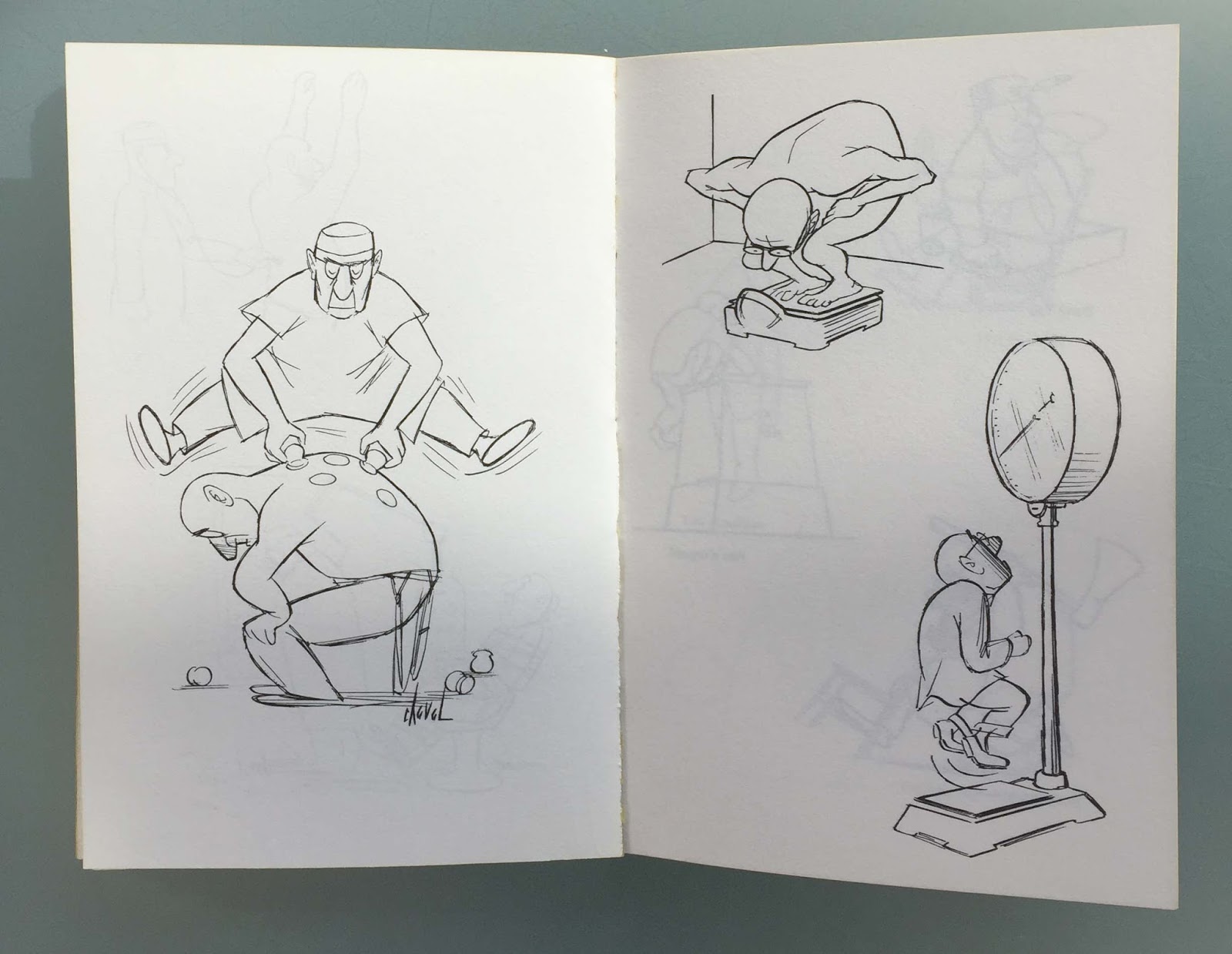
Article by JMB
Obviously, a rare book is not inevitably very old, unlike those I formerly presented here. There are also several various reasons for books being a rarity. The collection
Micrologies I show you now, is just over fifty years old and it is not a limited edition. So, why is this French ten books series so hard to find complete?

I presume it is the very small size (66 x 66 millimetres) of these thin books that caused them to be mislaid, then to be lost. This could be the main reason, but also, in spite of their interest as an odd item, I suppose - as they have no title on the cover, just the cartoonist name - the possible buyers of that time did not first considered them as real books, and bookshop customers neglected to acquire these so-called gadgets. Their title is printed on page 1 (see hereunder) and, probably because of the lack of mention on the cover; these titles were hardly ever mentioned in the cartoonists’ bibliographies. So they kept almost unknown by collectors.

Under a coloured cover, every book has 24 pages of black and white cartoons, most of them without captions, and one cartoon per page. As a result of this size and pagination, each book weighs 4.9 gram! There is no mention of sale price on the four first books; one can logically suppose they were sold for the same price as the others: 0.50 New French Franc each.

Ami is the penname of Georges Tardy (1924-2005). His favourite character is this naughty boy whom nickname can be translated in “
Awful Joe”.
Exactly like the Ami book here above, each
Micrologies book has a black cotton link set in its center fold and tightly knotted all around, letting a part running over. This is not for a necessary binding purpose, as there is one staple already. It is just for an attractive good looking. I thought it is useless to show it on every cover picture, so here are just plain covers.

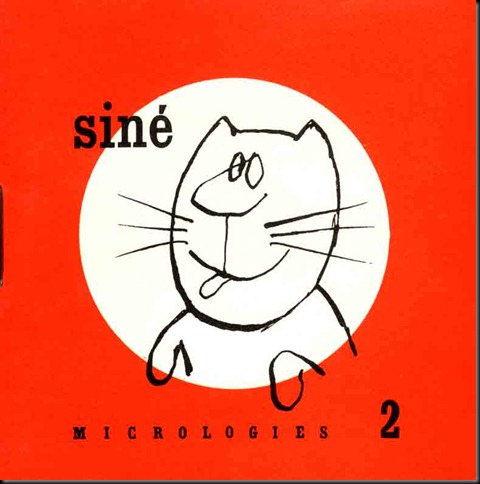
Siné (1928- ) has two books in this series. Every cartoon of this first book is a pun with the French word “chat” (cat). In 1964, he published in the USA a book of dawn puns using the English word “car”, titled
Siné’s French Car-toons.


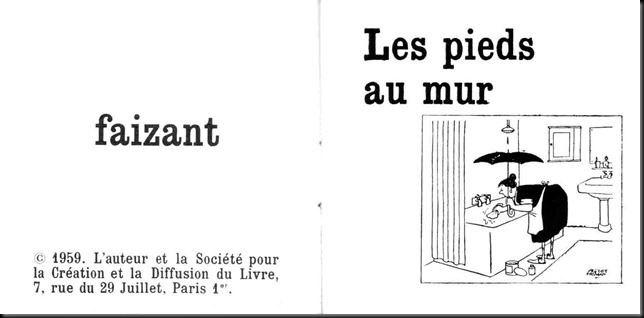
This is the very first cartoon book by Jacques Faizant (1918-2006) who began with gag cartoons, but is better known as the editorial cartoonist he was then after for forty five years.

Most of
Faizant’s works, humorous cartoons as well as political cartoons, have a caption.
 Mose
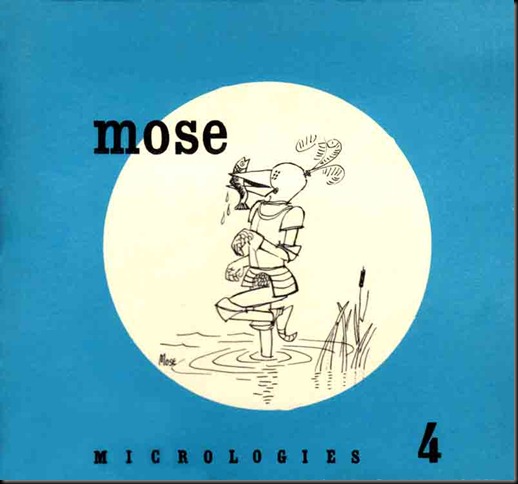
(Moïse Depond, 1917-2003) is one of the best initiators of gag cartoon without caption in France.


Mose’s work’s atmosphere is marked by unusual or absurd situations, sometimes mixed with tragedy. It is too bad his talent hardly gave him all the success he deserved.
 Tetsu
(Roger Testu, 1913-2008) too was a specialist of gag cartoons without caption.


All long his career, Tetsu pictured the ordinary life of gloomy people with a just a little touch of strange bitterness. His humour came from the gap between sad reality and a surprising detail.
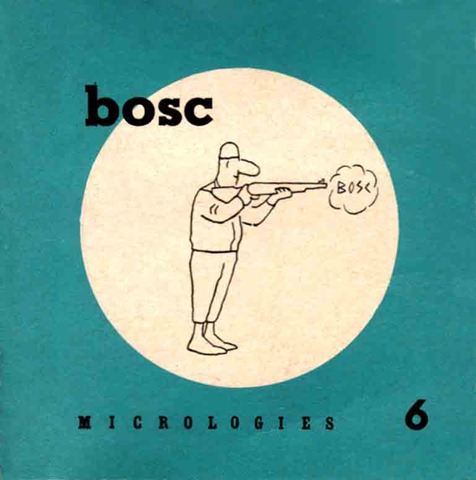
Like Mose, Chaval and Maurice Henry, but few years later,
Bosc (1924-1973) was one of the few French great masters of cartoon without caption.


The antimilitarist he became, back from the Indochina war, drove him to mostly lampoon the military. Although a gag cartoonist, as a de Gaulle opponent he also drew
political cartoons.

In postwar France,
Siné was the first cartoonist to systematically blast the usual good taste, and especially to violently battle with all authorities. He was and is remaining the great iconoclast of his profession and an anarchist.
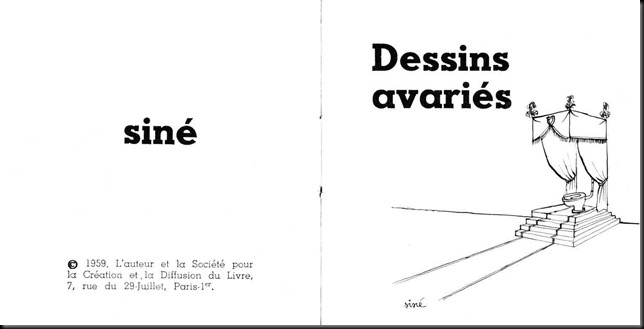

A frame with his signature and one knot at its upper part is typical of early Siné cartoons.

Among the pioneers of French cartoon without caption,
Chaval (Yvan Le Louarn, 1915-1968) is remaining the most famous. His success overshadowed Mose’s popularity.
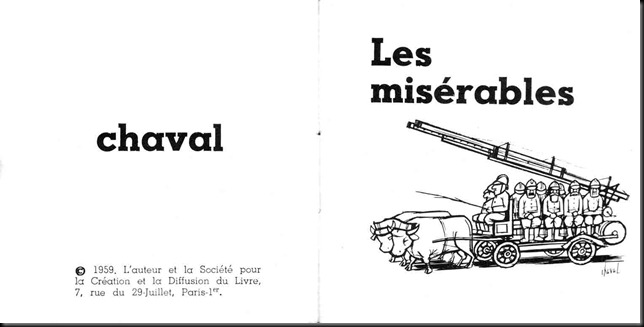

Chaval was also an excellent writer of humorous short stories and a
short films maker too.
 Maurice Henry
(1907-1984), poet and artist, took part in every surrealist exhibition for twenty years from 1932. He was a gagman for several films. As a cartoonist for about forty years, he published in some 350 papers and magazines.

He was the best spreader of the surrealist spirit through the press. His greatest drawn book is: “
Les metamorphoses du vide”, released in 1955 – a rare book when it is a copy of the very first edition, with a pierced cover.

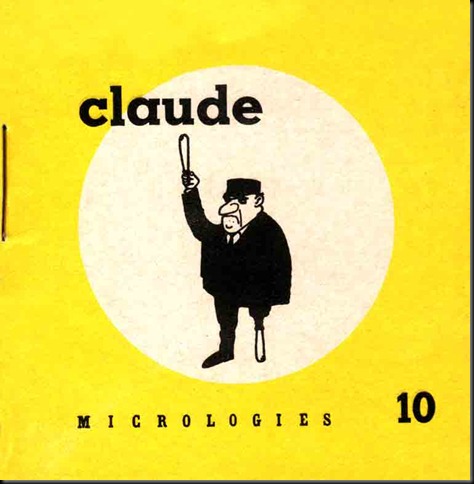
In this book by Claude (Michel Godement, 1931- ), only the cover shows a gag cartoon; each one of the 24 other drawings is a kind of rebus, a pun with the name of a Paris tube station.

Every answer to this sort of game is printed upside down, at the bottom of each page

In fact, Jean-Jacques Pauvert, the publisher of this
Micrologies series, was not the inventor of such cartoon micro-books. Four years earlier, a German publishing house, Bärmeier & Nikel, launched its own series:
Die kleinen Schmunzelbücher. These books are not square: their size is 70 x 60 millimetres, but they also have 24 pages fixed by one staple and there is a fiber link set in their center fold too!

That German series was published from 1955 to 1962, at least. The two books shown here were printed in 1962 and the collection had 25 different books at that time. The one by Walter Hanel (1930- ) contains black and white cartoons, when the one by Friedrich-Karl Waechter (1937-2005) is printed in black and white plus additional red (for the lipstick marks featuring on every cartoon)

Well… it is the right illustration to end this article.
Kisses to all of you!
(JMB)