Showing posts with label reference work. Show all posts

Saturday, June 20, 2015

1815 - Waterloo - Exit Napoleon

18 June is not only my birthday, but it's also the day when the Battle of Waterloo took place, now 200 years ago.

In this commemoration year of Waterloo, I want to mention again the excellent cartoon (caricature) book  The Napoleontic Wars in Cartoons by Mark Bryant.(Grub Street London, 2009, 160 pages).

One cartoon below was published just 200 years ago.

If you like some other Napoleon cartoons, you can read the article I wrote on this blog in July 2010: "Waterloo, Napoleon, a bike and cartoon books"...


Below some pics I took a few years a ago during a cycle ride ...


Sunday, April 21, 2013

Vriend over Vijand - De Grote Oorlog in spotprenten by Paul Vandamme / Friend on Foe -The Great War in cartoons

Last Thursday I attended the presentation of Paul Vandamme's newest book 'Vriend over Vijand'  - De Grote Oorlog in Spotprenten (Lannoo, Belgium,  ISBN 978-94-014-0695-6, 40 eur)  . Title translation: Friend on Foe - The Great War in cartoons).  He couldn't choose a better place: the In Flanders Fields museum in Ypres. On the occasion of the publication of the  book by Uitgeverij Lannoo, a number of cartoons from the collection of the author and the IFFM are exhibited.
In the large cabinet the museum displays a number of original two- and three-dimensional caricatures, in the corridor hang eight large reproductions of famous caricatures.
 

Paul Vandamme is a belgian historian, history teacher and passionate collector of historic cartoons. In only a few years time he collected an impressive amount of WWI cartoon and caricature books, drawings, magazines and postcards from all over the world. In the book, a  reference work, about 400 historic cartoons tell and illustrate the history of WWI. The army of WWI cartoonists, armed with pencil and paper,  fought their battle to influence, to inform, to satirize, to boost morale... Magazines such as Simplicissimus (Germany), La Baïonnette (France), Punch (GB), Die Muskete (Austria), etc. published thousands of cartoons.


I've started reading the book, and I must say this an outstanding reference work. In about 10 chapters and 200 topics, the author tells the story of The Great War, starting in 1870 with the French-Prussian war and ending with the Pact of Locarno (1925). The drawings that  illustrate each topic have been selected with great care and fit perfect in the topic's context.  One notices that the author has spent lots of time in research. The author also explains the drawings in a comprehensive way. One of the most difficult things when I look at historic caricatures or cartoons, is trying to understand the drawings and their meaning. The author has done a good job and gives the reader a good insight in the different topics and cartoons.

Paul  was so kind to send us an English translation of some pages.  An English
translation of the book isn't available yet.
The book is available in Dutch and let's hope there will follow an English translation.

Maarten Vansteenberghe, publisher general non-fiction, Lannoo

Paul Vandamme signing the book I just bought...
many people attending the publication
one of the large reproductions hanging in the IFF corridor
Learn more:
Uitgeverij Lannoo
Standaard Boekhandel

Sunday, April 22, 2012

Scalarini: Il padre della satira (The father of satire)

In 2014, there will be in the ECC an exhibition of cartoons of the Great War (WWI 1914-1918). One of the artists we must show is the great Italian political cartoonist Giuseppe Scalarini (1873-1948). Yesterday Fernand and I met in Brussels with the kind Nando Levi and his daughter Noela and Antonio Garonzi. Scalarini was the grandfather of Nando. Nando told us a lot of interesting facts about his grandfather. There will be an article in Scherper about this meeting.

Antonio Garonzi, Fernand, Nando Levi, Noela Levi, Jan
We were given a well documented file and a Scalarini catalogue of outstandig quality: "Il veleno della storia".

Hereunder are some pictures of this catalogue. (the pictures are taken on the train..)


Antonio is the webmater of the official Scalarini website and he is proud to announce that the website soon will be available in English too. Visit the site to learn all about the great artist.


On YouTube, you can wath this videos about the work of Scalarini:

From Rai television:


Learn more:
www.scalarini.it
ECC article Giuseppe Scalarini
Join the Scalarini Facebook group

Saturday, November 12, 2011

Armistice Day 2011 - De Oorlog in Prent by Jan Feith (The War in cartoons)

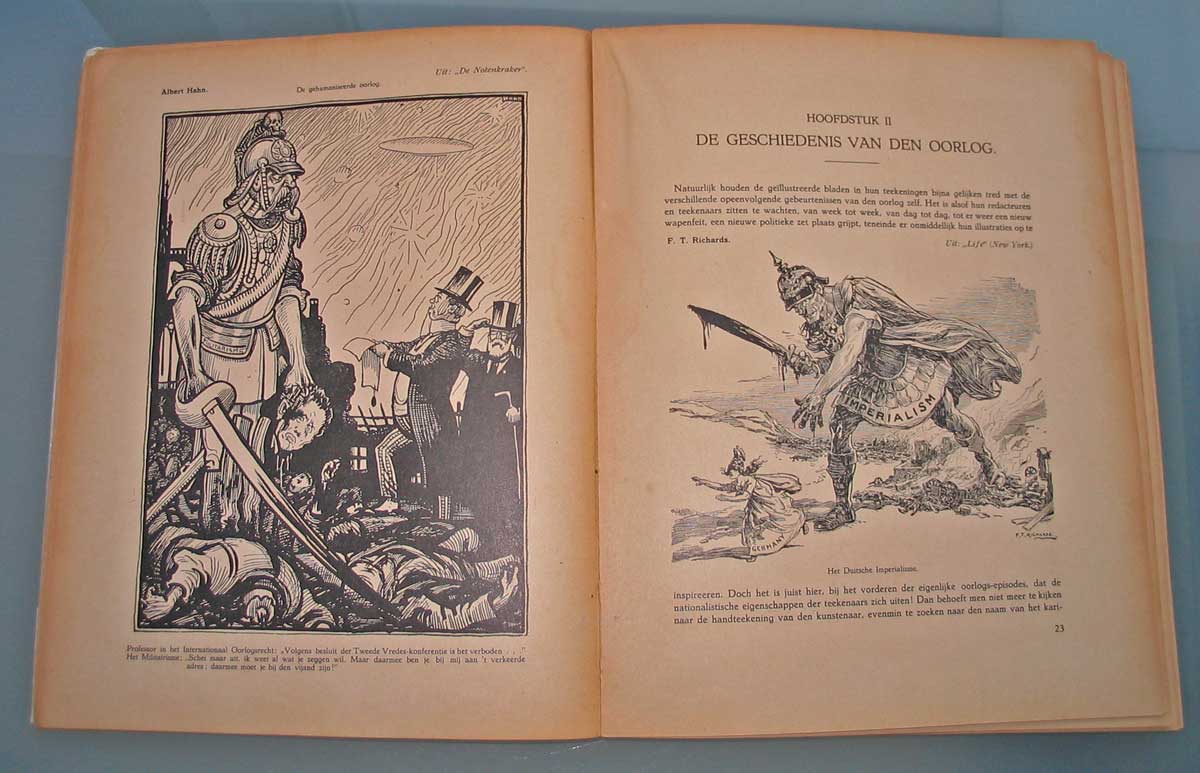
Is there a better day and a better place to buy an old book with political cartoons of the years preceding and the first year of World War 1? On 11 November 2011 about 11 o'clock and in Passchendaele I bought "De oorlog in Prent" by Jan Feith.


The book was published in Amsterdam in May 1915 (Scheltens & Giltay). As Holland was a neutral country during WWI, the author's point of view is "neutral" too. The subtitle of the book sounds "caricatures from the different countries". There are nine chapters in the book (190 pages): 1. The allegory of war 2. the history of the war 3. what one reproaches the other 4. ruined cities 5. their armed forces 6. war press in the caricature 7. sport as a motive of war 8. leaders of war 9. about neutrality and neutrals.


The book shows a selection of cartoons and caricatures published in newpapers and magazines in the different countries in Europe and the United States (Punch, Simplicissimus, Jugend, The Bystander, Kladderadatsch, Le Matin, Evening Sun, Avanti, Nebelspalter, etc. ) .
The coloured cover is a colour copy of another version of the book. The cover below, the original cover of this book is in black and white. I think this is the original edition of the book, but I am not sure. The edition with the yellow coloured cover can be a later one. If someone can help me find out, let me know.


Learn more:
Armistice Day 2010 - Brushes and Bayonets

Jan Feith on Wikipedia
Jan Feith on Lambiek.net
De Oorlog in Prent (info on Google Books)

Tuesday, June 8, 2010

Interview with cartoon historian Mark Bryant (UK)

He wrote several cartoon reference works, made me discover some important cartoonists and his books all are holding my attention ... my interest in the man behind the books was piqued. Time for an interview with the author who lives and works in London.

When or where did your love/interest for cartoons start?
How does one become a cartoon historian?
When did you first realize you wanted to be a cartoon historian?

Like most British schoolchildren of the 1950s and 60s I was brought up with comic magazines such as the Beano and every Christmas was spent with the annual cartoon collections by Giles of the Daily Express. However, I also enjoyed war cartoons from an early age - my father had been in the RAF in Burma during the war and brought back Jungle, Jungle, Little Chindit by Jon Musgrave-Wood (later Emmwood, political cartoonist of the Daily Mail) and collections of RAF cartoons featuring Pilot Officer Prune by 'Raff' (Bill Hooper).
My first professional involvement with cartoons was in 1984 when I was working as an editor in book publishing. After editing the biography of David Low, I commissioned biographies of Vicky (Victor Weisz) and Ronald Searle.
Soon afterwards I began compiling anthologies of cartoons, was invited to become the Secretary of the British Cartoonists' Association, organised three English Heritage commemorative blue plaques to cartoonists (Low, Vicky and H.M.Bateman) and wrote two biographical dictionaries of cartoonists and caricaturists. A number of other books on cartoon history followed and I have been writing two pages a month on the subject for History Today magazine for the past five years, have written obituaries on cartoonists for the Independent for the past 10 years and have contributed entries on cartoonists and caricaturists for the Oxford Dictionary of National Biography and other reference books. I have also lectured widely and curated exhibitions of cartoons.
In 1992 I began Park Art, selling cartoon books by direct mail and to specialist shops, galleries and museums, and the following year was co-founder of the cartoon book publishing company Park McDonald, of which I was also editor-in-chief (1993-96). I have also been a Research Associate for the British Cartoon Archive at the University of Kent, Research Consultant for the British Cartoon Forum and a consultant for the Cartoonist of the Year category for the British Press Awards.

Do colleagues take a ‘cartoon’ historian seriously?
My main interestis political cartoons, especially in wartime. My PhD is on this subject, going back to the Napoleonic Wars (and 'serious' artists such as James Gillray) but focussing in particular on the Second World War and Leslie Illingworth of the Daily Mail. There are many distinguished art historians working in the field of graphic satire. Also the reviews that I have received for my books and the fact that Prince Charles, Lord Baker, Michael Foot and others have contributed forewords to some of them make me believe that my work is taken seriously.

What does your family think of your writing?
Is this a fulltime job ?
When did you write/edit your first book and how old were you?
I have been a full-time freelance writer, editor, journalist, lecturer and exhibition curator since 1987 and have also served on the jury of a number of international cartoon competitions, worldwide. Prior to this I spent a decade as an editor in literary and academic book publishing. I am also a former director of the London Press Club, of which I was secretary (and editor of its magazine, Press News) for eight years.
Cartoon history is not my only interest. As a writer, my first published book, Riddles Ancient and Modern (written when I was 27) later received a Special Commendation in the best Specialist Reference Books of the Year Awards. I have also written a number of books on non-cartoon subjects, notably the biographical reference book Private Lives  and have compiled nine short-story and verse anthologies. I recently also wrote an official history of the famous literary book publishing company Constable (founded in 1795) 'Constable: a Brief History of Britain's Oldest Independent Publisher'. Many of my books are dedicated to family members so I hope they like them.

I found in my (early) book collection the books ‘The World's Greatest Rugby/Cat and Do-It-Yourself Cartoons’, edited by Mark Bryant. Can you tell us a bit more about those books?
This was a series commissioned by Exley Publishing for the gift market after a discussion I had with them at the Frankfurt Book Fair. My involvement was to assemble international cartoons on 11 different subjects (chosen by Exley) fromwhich Exley themselves made a choice. In some cases cartoons were even redrawn to fit their market. The title 'world's greatest' was Exley's, not mine. All are now out of print.

Where do you get your information or ideas for your books?
The material comes from a wide variety of sources - books, magazines, newspapers, historical archives etc. The ideas for the subjects of the books are either mine or are the result of discussions with publishers.

Wat is your favourite cartoon book? Why?
What’s your favourite cartoon? Why?
What kind of cartoons are your favourites? editorial? gag?...
I have no favourite cartoon, cartoon book or cartoonist and am constantly discovering new and amazing artists worldwide and throughout history. However, that said, I do treasure a lucky black cat cartoon drawn by my grandfather which I inherited on my father's death.

If you could have dinner with one cartoonist, dead or alive, who would it be and why?
Probably James Gillray or Robert Seymour - or any other cartoonist who committed suicide (Vicky, Ridgewell, Wallis Mackay, Kevin Woodcock et al.) - so that I could try and convince them to keep producing their amazing work.

What inspired you to write WWI and WWII in cartoons (or other )?
What was the hardest part to write those books?
Why should people, read ‘cartoon’ historic books?
What was one of the most surprising things you learned in creating your books?
I don't understand what people mean by inspiration and there is no particular motive behind any of my books (though part of the reason I wrote Illingworth's War in Cartoons was because I thought he had been unfairly eclipsed by Low and Vicky).
However, having written those particular four war books (World War I in Cartoons, World War II in Cartoons, Wars of Empire in Cartoons and Napoleonic Wars in Cartoons) I wish there had been something like them around when I was at school because they are certainly a very good way of learning history.
The hardest part was not the writing but the publishing - World War II in Cartoons first came out in 1989 and went out of print soon afterwards when the publisher went bust. I approached more than 30 publishers over the next 16 years until I succeeded!

Have you been in Belgium before? What was you impression?
My first trip to Belgium was to serve as a jury member for the Knokke-Heist cartoon festival many years ago. I have since been back to Brussels and Bruges and have always enjoyed my visits - especially the people, the food and the beer.

Do you have a message for the readers of Scherper, the Flemish cartoon magazine?
Congratulations on your excellent magazine and especially because it is in Flemish - I wish we had something similar in Britain (e.g. a Welsh-language cartoon magazine). Oh... and please keep buying my books!

Thanks a lot for this interview.

Learn more:


Monday, March 29, 2010

Oil and cartoon by Bayram Hajizadeh

Last week I was very honoured to receive the latest book written and edited by Mr Bayram Hajizadeh, Doctor of Philosophy, Honoured Art Worker of the Azerbaijan Republic and President of the Azerbaijan Cartoonist Union. I knew his previous books were very interesting and this new book is gratifying me a lot again. Not only by the fact that the cartoons in it at are excellent, but also by the concept of the book: a combination of history, art and humor.

The book is devoted to the 15th anniversary of the oil contract signed in Azerbaijan called "The Contract of the Century".

Oil and cartoon cover

In a first part, Mr Hajizadeh writes about the rich history of oil exploration in Azerbaijan from antique times, over Marco Polo, who was the first European to visit the Caucasus, until modern times. "If oil is the Queen, then Baku is her throne", emphasized Winston Churchill at the beginning of the 20th century.


"Our 'friends'" (1919)
In the second part we find the history of cartoons and oil in Azerbaijan.As capitalism was developing rapidly, there was a fertile condition for the formation of the cartoon as an independent genre. We learn that the people skillfully used cartoons and critical satiric drawings to declare their protests and discontents to oil mine owners, state officials and power circles. Foreign occupiers who tried to own Azerbaijan's oil and other natural wealth, were criticized. In the soviet period mostly exposed cartoon subject were shortcomings in the field of oil industry, anarchy prevailed in offices and organisations, office heads and directors, irresponsible state officials and directors of oil wells. The importance of satirical newspapers and magazines such as "Molla Nasreddin" (first issue 1906) and "Kirpi" (Eng. Hedgehog, first issue 1952) is well documented in the book.
Cover of the satiric magazine 'Kirpi' (1952, no 1)

B.Hajizadeh "Molla Nasreddin: -Azerbaijan -
a land of oil - is prospering day by day"
The third part contains the selected cartoons of the Molla Nasreddin cartoon contest 2009.
This contest was devoted to the 103rd anniversary of the first satiric and cartoon magazine in the East and in all Moslim countries - “Molla Nasreddin”. The theme was 'the importance of oil in the world'.

Here is a selection of some top cartoons out of the book:

Veselin Damyanov, Bulgaria

Vahid Jafari, Iran

Slawomir Luczynski, Poland
Shevket Yalaz, Turkey

Julio Angel Carrion Cueva, Peru

Ilya Katz, Israel
Angel Boligan, Mexico

Ferreol Murillo Fuentos, Costa Rica


I thank Mr Hajizadeh again for sending me this very nice book and his great work!

Learn more:
Petroleum Industry in Azerbaijan (Wikipedia)
Bayram Hajizadeh bio
Azercartoon
Some pages out of the book on Azercartoon

Cartoonbook file:


Previous articles on our blog:
World cartoon by Bayram Hajizadeh
Contemporary cartoon of Azerbaijan