Sunday, April 24, 2011

Euro-Kartoenale 2011 Catalogue

catalogue cover
"Shoes" is the theme of the 18th edition of the Euro-kartoenale of Kruishoutem.
In the foreword,Rudy Gheysens, president of the ECC writes:
"The modern cartoon is indeed more than a drawn joke: it is also poetry, philosophy or the expressions of our harsh reality."

The catalogue costs 15 eur ( contact ECC).


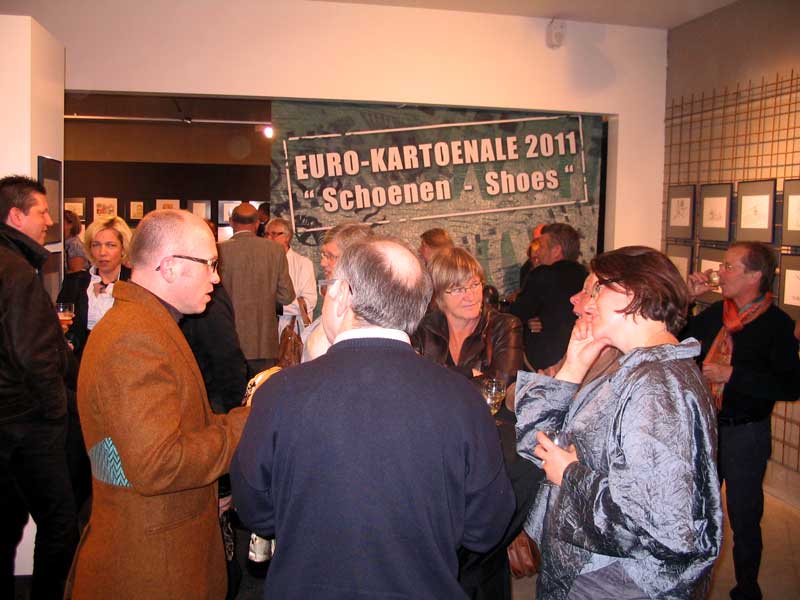
opening of the exhibition (on the left side, you recognize Andy Riley)
winning cartoons
impression of the exhibition
winner Allessandro Gatto
3-d cartoon Marc De Bel
3-D cartoon 
prize winners - Cost,  Pol Leurs, Agim Sulaj,
Allessandro Gatto, Ludo Goderis

Learn more:
More pics on ECC Facebook page
Pics and information about the Euro-Kartoenale on the ECC website

Thursday, April 14, 2011

Another very old book

Article by JMB


Grose's book: Principes de Caricatures is the first ‘How to Cartoon’ published in France, but the book: ‘Musée de la caricature’ (Museum of Caricature) by Jaime is a survey of satirical and humorous etchings from the Middle-Ages to the Napoleonic period. It is the very first French methodical historical analysis of caricature. For this very reason, it deserves to be presented too.


There is no mention of a limited edition and I don’t know how many copies were printed, but as this book was published in 1838, of course it is hard to find. It was never be reprinted.

There are two volumes with 230 numbered etched plates on 226 leaves (sixty-five hand-colored and fifteen folding), and 320 pages of text by fifteen authors explaining every caricature, its situation, its characters and meaning, as well as its historical backgrounds.

Here is a quotation about this book: "The reader soon realized that the history of France for the preceding five centuries could be studied through caricatures, and that valuable insights could be found about the history of religious conflicts, class struggles, and attitudes towards authority" (Aaron Sheon, "The Discovery of Graffiti," Art Journal, Volume 36, No. 1 [Autumn 1976], p. 17).


Ernest Jaime (1802-1884) is both the editor of this collection and the gifted engraver of all these caricatures which he exactly copied from the original sources.

If each volume is 22 x 28 cm and it has almost the same number of etchings. The first one runs from the 14th century to 1788, when the second volume runs from the French Revolution to Napoleon’s fall in 1815.

The content of these volumes was originally issued in eighty parts between 1834 and 1835, which were distributed to subscribers. Each part had four pages of text to which were added two or three etched plates on full leaves. The first parts of Museum of Caricature were published in one bound volume by Hautecœur & Martinet in 1834, but this collection only contains 144 plates. Its subtitle is: Picturesque History of French Satire, Malice and Gaiety

XVIIth century
The complete edition in two volumes is subtitled ‘Collection of the Most Remarkable Caricatures from the 14th Century till Nowadays’. Indeed it deals as well with notable political events as with particular social themes of that times: manners, fashion and mores; such as the difficulties in Paris, like the French writer Nicolas Boileau described them in the verses of his satirical lampoon ‘Satires”, in 1666.


The French Revolution


The French Revolution


At the end of this article, I apology for not having cleared up every cartoon but set some hypertext links in place of, as it had been a too long and hard task to detail each one and explain it in English. Nevertheless, I would not finish this presentation without an explanation of this last caricature about Napoleon and Field Marshal Ney. I must first say that French humor is often based on puns: we, French people, use and love to play with words. This plate is entitled ‘Le serment de Ney’ (Ney’s oath). But since ‘serment’ and ‘serrement’ (squeezing) sound similarly and since ‘Ney’ and ‘nez’ (nose) sound the same, the Ney’s oath is also understood as a ‘nose squeezing’

article by JMB

Monday, April 11, 2011

MATT cartoons - Amours d' Animaux

I recently discovered this nice cartoon book by Matt. It's difficult to translate the title. It could be 'Animal love affairs' or 'loves of animals' or maybe 'Animal Passion' could suit too. The purpose of the book is to humanize  animals and look at the world through the animal's eyes.


The book has been published by Glénat, France (1994,ISBN 2-7234-1758-1)

Carlos Matera (Matt) was born in Buenos Aires in 1963. He started his career in 1984 drawing publicity using graphic humor. In 1985 he published his first cartoons in various Argentin magazines. Since 1990, he lives in Europe.

The cartoons are very colourful and I 'm very sure Matt has been inspired by the great Mordillo (also born in Argentina).


This is great art: look at the stripes of light!


Learn more:

Matt has some blogs where you can see more of his nice cartoons:


Sunday, April 3, 2011

About a rare edition of a not rare book


Article by JMB

Before presenting some other rare books, I react on Stephen Worth's recent post and I seize the opportunity to show you a book that is being constantly reprinted since the turn of the 18th / 19th century: Lavater’s essay on physiognomy.
Johann Kaspar Lavater is a Swiss pastor who is particularly famous for this work, of witch the original version is first published in German, both in his country and in Leipzig: Physiognomische Fragmente zur Beförderung der Menschenkenntnis und Menschenliebe (1875-1878) and that is first published in French in The Netherlands in four successive volumes: 1781; 1783; 1786 and 1803 for the fourth one that is a posthumous volume summarizing his theories. Like every old first publishing, these books are hard to find, particularly in a complete set, since its 4th volume is particularly rare. This edition’s 1st volume has some texts which were unpublished in the German edition.


The French title can be translated in Essay on Physiognomy to Let Know Man and to Love Him. The first volume has 294 pages and 14 additional plates. The second volume has 404 pages and 78 additional plates.


The third volume has 306 pages and 53 additional plates. The fourth volume has 328 pages and 48 additional plates. There are also many other engravings in the text of these volumes.
These books are big: 31 x 37 cm and they weigh over 15 kg. Soon after this edition, a very abridged edition, is published in France as a pocket book with only 33 plates: Le Lavater portatif (The Portable Lavater) ; it has - at least - six editions: from 1806 to 1815. Then a ten volumes edition is published in 1820. Some new editions come in 1845 and in 1850 and so on in France. This Essay was republished many times in Europe and overseas too till nowadays .


His aim is to decipher the human soul from the facial features, according to his first belief that "man was created similar to God’s image". It is to say that the exaggerations of caricature are not his ‘cup of tea’, as he considers them as useless and maybe like a kind of blasphemy! At the same time, the caricature theorist Francis Grose , also considering the angles and proportions of different facial features, sets rules for this art. But even exaggerations have their limits and Grose recommends charging the peculiarities of the caricatured peoples with a judicious moderation, to make them not ugly but simply ridiculous. His purpose is to correct customs by laughing at these people - castigat ridendo mores.


Lavater does not laugh; he is just interested in morals as he deciphers it from mankind's physical aspect. Beauty (what he wants to quantify in his studies) is a sign of virtue and what deviates from his ideal standards is an evidence of vice, maliciousness or stupidity.


Lavater develops his analysis through many illustrated examples of famous people (Socrates, Caesar, Locke, Catherine II, Jesus Christ, etc...) or general characters (like the four temperaments: sanguine, phlegmatic, choleric, and melancholic).


Among other topics, he deals with the form of skulls, reading the silhouettes of the various faculties of the human spirit, comparing national aspects, etc...


He incorporates ancient theories developed by Aristotle in particular; his book is part a result of De Humana Physiognomonia (1586) by della Porta, the conference of Le Brun on the Passions of the Soul (1668) distributed by engravings of Sébastien Le Clerc (1692), and  Camper's study about lines of animality.


If this work divided the scientific Europe, its success was immense. His influence has continued in the nineteenth century and even beyond, through Gall’s theories of phrenology or Lombroso’s ‘born criminal’.

article by JMB

Sunday, March 27, 2011

Cartoon Bridging Cultures - GreekARToon 2006

A pleasing cartoon catalogue is the catalogue of the 1ste International Cartoon Contest, by GreekARToon.(ISBN 960-89471-1-1,  Ahthens, 2006).


The theme was 'cartoon bridging culture'. In the preface, I read:  "the art of Cartoon, indeed, is a "charismatic and gifted" art form and concurrent of the evolution of man, human society and technology, as recorded from the ancient Phlyacographves on the walls or on ceramic pottery to the pages of printed or electronic press, and to the books that have been produced by other means. Despite the evolution in the means - tools of production, its manifold significance and role continues  unaltered. That is to say, it is the endurance of the archaic meaning and significance of the historical  and social 'need' that produced it, which is nothing but a 'handcrafted' interpretation and divestment of an instant momentum, that does not only 'ridicule - mock - satirize' the sacred  and the profane ,or the power relations. Equally, satirizes the modern and multifaceted culture of everyday life, in an age of globalization, of unprecedented advancement, but also an age of piling problems, violence and conflicts.
In other words, Cartoon , as a visual art, but also deeply as a 'political' art, is the meeting point and the channel  of communication between the various bearings of the 'comic and the tragic'. (GREEKARTOON)


Dalcio Mahado - Brazil
Robert ROUSSO - France
Osmani Simanca - Brazil
Che An Yong - China

Musa Gumus - Turkey
Clay Bennett - USA

Oley Dergachov - Canada


Albert Rousso - France


Tommy Thomdean - Indonesia

Jin Hui - China

Learn more:
www.greekartoon.gr

Sunday, March 20, 2011

About (almost) rare books

Article by JMB

Jan asked me to present some very rare books. At first, one must ask: why to do it? If a book is over than rare, it would be impossible for this blog’s readers to find it. So, what's the use to mention it, apart from showing off in the style: look what I proudly own when you will never get it! This is not my aim, and I already pointed out my position by adding an “almost” to this article’s title. In fact, apart from a single copy book, of course, there is always a hope to find some rarity. In addition, our friend collectors know that, in collecting, the most important thing is not to possess an even very rare book, but to keep searching for the next book, a hard to find item which one runs after for years and years. The real pleasure doesn’t come just with a “great shot”, but at a permanent hunting.
After these necessary forewords, I wish to show you a book that is really hard to find, as it is both old and was a limited edition. It is the very first theoretical study about caricature, ever published in France.


Although not numbered, this book is attested from several serious sources to have been published in 200 copies


This first French edition, published in 1802 (year 10 of the French revolutionary calendar), was preceded by two English editions, titled: Rules for Drawing Caricaturas: with an Essay on Comic Painting. The first one, in 1788, was illustrated by a frontispiece and four plates; the second one, in 1791, was illustrated by twenty one plates. There was also a German edition which had, like the French edition: a frontispiece and twenty eight plates (including six folded plates). Oddly in France, the author’s first name is printed: François, when it is really: Francis.


For the French Mint, Ronald Searle, who had some plates from the English second edition, designed a medal dedicated to Francis Grose and his book, in 1981.


In the French book, before the plates: a text in fifteen pages details Grose’s rules for drawing caricatures, then comes his essay about comic painting along seventeen pages, and nine pages contain the explanations, or subtitles of all the plates.


Francis Grose (1731-1791) is not only a caricatures’ theoretician, but also a regular practitioner (he drew most of this book illustrations). Since his youth, he is keen about antiquities and drawing and is taught in a Fine-Arts School.


Although the Captain Francis Grose military career was not long, he was proud of his grade and uses it for all his life long, when his main features are to be an artist and an active scholar.


He publishes ten volumes of Antiquities of England and Wales, two volumes of Antiquities of Scotland, a Dictionary of the Vulgar Tongue: A dictionary of buckish slang, university wit, and pickpocket eloquence, and a Guide to Health, Beauty, Riches and Honour. Grose is in Ireland to prepare a book about its antiquities, when the obese he is since decades, suddenly died of an apoplectic seizure. With humour, Ronal Searle said about him: “It seems he is a top rated archeologist among the ones who published as much books’ weight as their own weight”.